50k fuelling plan for a first trail ultra, hour by hour
What to eat and drink from two days before a first 50 km trail race to the meal after it, with a worked seven-hour example.

By Jake Vita, Head of Marketing
- Published
- 14 min read
Key takeaways

Contents14 sections
- Key takeaways
- How long does a first 50k take?
- Rehearse the plan on long runs first
- What to eat in the two days before a 50k
- What to eat on race morning
- A 50k fuelling plan, hour by hour
- The first hour
- The middle hours
- The last third, when eating gets hard
- If you will be faster or slower than seven hours
- What to do when the plan slips
- What to eat after a 50k
- Frequently asked questions
- Sources
Plan a first 50 km trail race in hours. On rolling ground most of the field takes between six and nine, and a plan that works across that whole span is short enough to remember. Eat 30 g of carbohydrate on every half hour and 20 g on every hour, starting 30 minutes after the gun, and drink to thirst.
That comes to a little under 50 g an hour, inside the 30 to 60 g range a first-timer should work in. This page sets it out from two days before the race to the meal afterwards, with one worked example and what to do when it goes wrong. The reasons behind the numbers are in our guide to ultra running nutrition. Every figure here is for healthy adults and is a starting point, not a prescription.
How long does a first 50k take?
Longer than a marathon time suggests. The 2026 results of the Hundred Hills 50km in the Chilterns, a course with 1,200 m of climb and a nine-hour cut-off, list 413 finishers with a median time of 6 hours 33 minutes. The middle half of the field came in between 5 hours 40 and 7 hours 19, and 38 runners took more than eight hours. The organiser's race report says about a quarter of the starters were running their first ultra.
The South Downs Way 50km in June 2026, with a similar amount of climb, the same cut-off and what its organiser calls hard-packed chalky trails, had 305 finishers and a median of 6 hours 10 minutes.
Neither set of results says which finishers were first-timers. If this is your first, assume you will be in the slower half and plan for six and a half to nine hours.
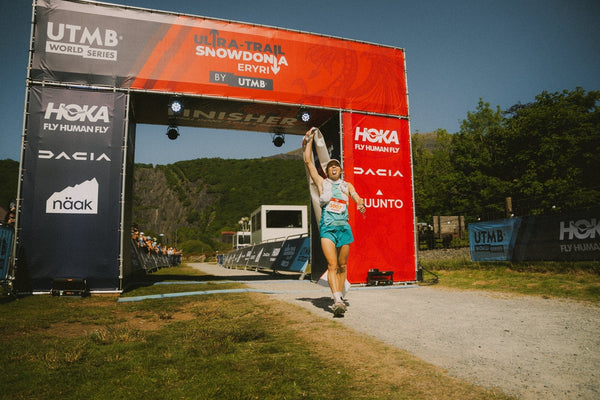
Mountain races are a different matter. The Eryri 50K in north Wales is listed by its organiser at 56 km with 3,400 m of climb and a 14-hour time limit. The plan below still applies there, because it is counted in hours. You multiply by more of them.
Rehearse the plan on long runs first
Nothing on this page should happen for the first time on race day. Practise your race fuelling on at least one long run a week for at least two weeks beforehand, and ideally for a month or more. If the full amount is uncomfortable, begin lower and add about 10 g an hour at a time once the last level sits well. Use the food you will race with and carry it in the vest you will race in. Our article on gut training covers how.
What to eat in the two days before a 50k
Carb loading applies to any race lasting more than 90 minutes, so it applies here, even though the pace will be gentle. For the last two days, eat about 10 g of carbohydrate per kg of body weight each day. For a 70 kg runner that is 700 g a day.
That is a lot of food. Make it low in fibre to go easy on your gut (white rice, pasta, bread, potatoes, juice) and spread it across the day instead of saving it for one enormous dinner. Eat nothing you haven't eaten before a long run. There is a fuller version, including the night before, in carb loading for ultras.

What to eat on race morning
Eat a carbohydrate-rich, low-fibre breakfast two to three hours before the start, about 2 g of carbohydrate per kg of body weight. That is 140 g for a 70 kg runner. The closer to the start you eat, the smaller the meal should be. The 2027 editions of the two races above start at 08:45 and 10:00, so for races like these it is breakfast at home or in the car at a normal hour.
One gel or the equivalent, 20 to 30 g of carbohydrate, in the last 15 to 30 minutes is optional. Some athletes also take a stronger electrolyte drink, about 500 ml, in the hour or two before a long, hot race. Try both in training first.
A 50k fuelling plan, hour by hour
The example runner finishes in just under seven hours. To keep the course honest, the aid stations sit where the Hundred Hills 50km puts its five, and the arrival times are the median splits of the 57 runners who finished that race between 6 hours 45 and 7 hours 15 in March 2026. We have no connection with the race. Its 2027 page lists Precision Hydration gels, chews and drink mixes on the tables alongside water, cola, fruit, sandwiches and savoury snacks, and requires every runner to carry bottles holding at least one litre.
The other assumptions are these. Carbohydrate comes from food in the pockets, in three forms: a gel with 30 g, a bar with 30 g, and chews with 10 g each. Fluid comes from two 500 ml flasks, one of plain water and one with an electrolyte tablet in it. Aid station food is eaten when it appeals and counted as zero.
| Hour | On the course | Eat | Carbohydrate | Sodium comes from | Drink |
|---|---|---|---|---|---|
| 1 | Start. Nothing for 30 minutes | Gel at 0:30 | 30 g | The electrolyte flask | To thirst |
| 2 | Station 1 at 10.6 km, about 1:21 | 2 chews at 1:00, gel at 1:30 | 20 + 30 = 50 g | 2 chews (about 107 mg) and the flask | To thirst. Refill both flasks |
| 3 | Station 2 at 17.9 km, about 2:18 | 2 chews at 2:00, bar at 2:30 | 20 + 30 = 50 g | 2 chews and the flask | To thirst. Top up |
| 4 | Station 3 at 23.3 km, about 3:06 | 2 chews at 3:00, something salty from the table, gel at 3:30 | 20 + 30 = 50 g | 2 chews, the flask and the table food | To thirst. Refill both flasks |
| 5 | Station 4 at 32.2 km, about 4:16 | 2 chews at 4:00, bar at 4:30 | 20 + 30 = 50 g | 2 chews and the flask | To thirst. Refill both flasks |
| 6 | Station 5 at 41.4 km, about 5:37 | 2 chews at 5:00, gel at 5:30 | 20 + 30 = 50 g | 2 chews and the flask | To thirst. Refill both flasks |
| 7 | Finish at 50 km, about 6:59 | 2 chews at 6:00, gel at 6:30 | 20 + 30 = 50 g | 2 chews and the flask | To thirst |
| Total | 6 h 59 min | 5 gels, 2 bars, 12 chews | 30 + (6 x 50) = 330 g, about 47 g an hour | 12 chews (about 640 mg). The rest from drink and food | No set amount |
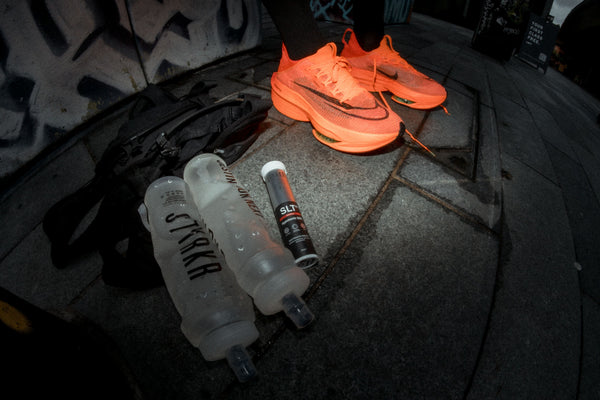
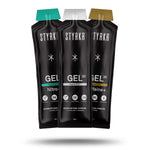
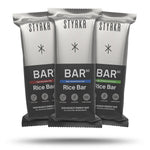
Put into STYRKR products, the gel is a GEL30, which has 30 g of carbohydrate and no sodium. The bar is a BAR30, with 30 g of carbohydrate. The chews are CEL50, sold as a pack of five chews of 10 g each, which makes 50 g of single-source glucose and 267 mg of sodium per pack, or about 53 mg a chew. Three packs cover the 12 chews in the plan with three to spare. Any gel, bar or chew with the same grams on the label does the same job, so do the sum from whatever you train with.
Where the sodium comes from
The usual starting range is 300 to 600 mg of sodium an hour in efforts over two hours, in heat, or if you sweat heavily. Sweat losses vary a lot between runners, so treat it as a place to begin.
Gels carry none. In this plan the chews supply about 107 mg an hour from the second hour on (2 x 53 mg), and the drink supplies the rest. The guide for drinks is about 500 to 700 mg of sodium per litre. An SLT07 Berry 500 tablet has 500 mg of sodium and is made up in 500 ml, which is 1,000 mg per litre in that flask. Alternate it with the plain water flask and what you drink averages 500 mg per litre.
How much sodium that gives you an hour depends on how much thirst has you drinking. At 400 ml an hour it is 200 mg from the drink plus 107 mg from the chews, 307 mg in all. At 800 ml an hour it is 400 mg plus 107 mg, 507 mg in all. Both sit inside the range. Anything salty you pick up at a station is on top. Carry one tablet for each refill of the electrolyte flask, six at most on this course.
How much to drink
Drink to thirst. For most people that works out at roughly 400 to 800 ml an hour, more in the heat. Do not force fluid down, and never drink so much that you gain weight during a race. Drinking far more than you sweat can dilute blood sodium (hyponatraemia), which is dangerous, and electrolyte drinks do not protect you if you overdrink.
Those figures are useful for one job, which is deciding how much to carry. The longest stretch between stations in this example takes about 1 hour 20 minutes, and at 400 to 800 ml an hour that is roughly 550 to 1,100 ml. Two 500 ml flasks cover most days. On a hot one, add a third.
The plan keeps carbohydrate in your pockets and out of your flasks on purpose. How much you drink changes with the weather, and if your carbohydrate is dissolved in the drink, your intake changes with it. That is our preference and no trial settles it. A carbohydrate drink you have practised with is fine. Count its grams from the label and take them off the food.
The first hour
The first hour feels easy and nobody is hungry, which is how it gets skipped. Start fuelling in the first 30 to 45 minutes. In the plan that means one gel at 30 minutes.
Set a repeating 30-minute alert on your watch before the start and eat when it goes. The hourly total matters more than the exact minute, so if the alert catches you on a steep descent, eat at the bottom.
If nerves have you sipping constantly on the start line, stop. Thirst is the guide from the first minute.

The middle hours
From the second hour to about the fifth the pattern repeats, with two chews on the hour and a gel or a bar on the half hour. Eat the bars on a climb if you can, because chewing is easier at a walk, and swap a bar for a gel when the half hour falls on a fast stretch. That is practice from experienced runners, and no study tests it.
Aid stations come round every 50 to 80 minutes at this pace. Do the same things in the same order at each one. Fill both flasks, drop a tablet in one, take a piece of something salty if you fancy it, and leave. Restock your front pockets from the back of the vest while you walk out. If the table carries a sports nutrition brand you have not trained with, the middle of your first ultra is a poor place to try a full serving of it.
The last third, when eating gets hard
Runners commonly report that somewhere after 30 km sweet food loses its appeal and chewing starts to feel like work. This is where plans get abandoned.
Lower the target before you drop it. The beginner range starts at 30 g an hour, so one gel an hour, or one chew every 20 minutes, still counts as fuelling. In the example the bar scheduled for 4:30 can become a gel, and the chews can be taken one at a time. Cola from the station table is carbohydrate too. We count it as a bonus because nobody measures a cup at a trestle table.
For scale, in one study that weighed everything five runners ate during a 120 km race, they averaged about 44 g an hour. A first-timer who holds 30 to 50 g an hour through the final two hours of a 50k is doing well.
Caffeine is optional and belongs here only if you already use it in training. The research dose is 3 to 6 mg per kg of body weight about an hour before exercise, starting at the low end, and in long races the usual practice is small repeat doses of about 50 mg an hour later on. Single doses up to 200 mg and up to 400 mg across a day are considered safe for healthy adults. Pregnant or breastfeeding women should stay under 200 mg a day, and under-18s and anyone told by a doctor to avoid caffeine should leave it out.

If you will be faster or slower than seven hours
The hourly pattern stays the same. The total changes with your time, and so do the gaps between stations.
A runner finishing in about five and a half hours eats ten times, from 0:30 to 5:00. That is five 30 g items and five pairs of chews, 150 g plus 100 g, 250 g in all or about 45 g an hour. Runners who finished the Hundred Hills course at that pace reached the stations every 35 to 70 minutes, so two flasks are plenty. Running jostles the gut more than other sports do, so most runners sit in the lower half of the range whatever their pace. If long runs have gone well at 60 g an hour and you want more, the extra has to come from a glucose and fructose mix, because glucose alone tops out at about 60 g an hour. Treat 90 g an hour as the ceiling, and only with a gut that has been trained up to it.
A runner finishing in about eight hours 40 minutes eats sixteen times, from 0:30 to 8:00. That is eight 30 g items and eight pairs of chews, 240 g plus 160 g, 400 g in all or about 46 g an hour. The slower runner needs more food than the faster one, which is easy to get backwards when packing. The gaps stretch as well. Finishers at that pace took up to 1 hour 45 minutes between stations, which at 400 to 800 ml an hour is roughly 700 to 1,400 ml. Carry a third flask.
If 47 g an hour proved too much in training, run the same clock at the bottom of the range. One 30 g item an hour for nine hours is 270 g. For other distances and other products, how many gels for an ultra has the sums.
What to do when the plan slips
It will, somewhere. Most of what follows is coaching practice. Where there is evidence, it is named.
You missed an hour
Do not try to pay it back in one go. The gut absorbs glucose at about 60 g an hour at most, and even runners with trained guts are advised to stop at 90 g. A double helping to make up for a blank hour is 100 g, above both.
Eat the next scheduled item now and carry on with the pattern. If you lose a full hour in the example, you finish on 280 g, which is still 40 g an hour.
You feel sick
Nausea is common in long races. In a study of a 161 km race run in temperatures up to 39 °C, 57% of the runners studied reported nausea or vomiting. A 50k is far shorter and usually cooler, and plenty of runners still meet it.
The mistake is to stop eating for the rest of the day. The usual advice from experienced runners and coaches is to slow to a walk, cool down if it is hot, take small sips, and restart with small amounts of whatever seems least unpleasant, which is often a single chew or a mouthful of something plain. No trial stands behind that advice. When things settle, pick the schedule up at 30 g an hour and build back.
Do not take extra salt as a cure. In that same study, a small one, how much sodium runners took in was unrelated to whether they felt sick. Do not force fluid down either.
If you are vomiting repeatedly or feel confused, stop and find the race's medical team.
The next station is a long way off
Check the gaps in the organiser's guide before race day and turn each distance into time at your pace. A stretch that will take you two and a half hours needs 75 to 150 g of carbohydrate in your pockets when you leave the last station (2.5 x 30 to 60 g). For fluid, the same 400 to 800 ml an hour gives 1,000 to 2,000 ml as a guide to capacity, so a one-litre minimum will not be enough on a warm day. Fill everything before you leave, and put tablets where you can reach them.
Station spacing varies a lot between races. Our UK ultra and trail race calendar compares it for the main UK events.
You run out of your own food
Eat from the table. No trial has shown that gels beat ordinary food over a long race, or the reverse, so any carbohydrate you can face will do. If the choice is a sports product you have never used, take a small amount and see how it sits before the next.
You cramp
Nobody has pinned down exactly what causes cramp during exercise. Fatigue plays a large part. Keeping up with fluid and sodium supports hydration, and some athletes find it helps, but it is not proven to prevent cramp. Ease the pace, keep to your eating and drinking, and read our article on cramp in ultras before the race.
What to eat after a 50k
Within the first hour or two, have 20 to 40 g of protein and about 1 g of carbohydrate per kg of body weight, which is 70 g for a 70 kg runner. Appetite is often poor after a long race, so eat whatever appeals from the finish-line food and have a normal meal later.
If you weighed yourself before and after, drink about 1.5 litres for each kg you have lost, with some sodium, spread over the next few hours. If you didn't, drink to thirst with salty food. The days that follow are covered in recovering from an ultra marathon.
Frequently asked questions
How many gels do I need for a 50k?
What can I eat during a 50k if I don't like gels?
Sources
- Hundred Hills 50km 2026, results. Centurion Running. https://centurionrunning.com/raceresult/67d93d7e0709887507f425c9
- Hundred Hills 50km 2026 race report (17 March 2026). Centurion Running. https://centurionrunning.com/reports/2026/hundred-hills-50km-2026-race-report
- Hundred Hills 50km 2027, race page and aid station table. Centurion Running. https://centurionrunning.com/races/hundred-hills-50km-2027/aidstations
- South Downs Way 50km 2026, results. Centurion Running. https://centurionrunning.com/raceresult/685922e29e86fbaa1fdc8b39
- South Downs Way 50km 2026 and 2027, race pages. Centurion Running. https://centurionrunning.com/races/south-downs-way-50km-2027
- Eryri 50K race page. Ultra-Trail Snowdonia Eryri by UTMB. https://eryri.utmb.world/races/Eryri-50K
- Hoffman MD, Stuempfle KJ, Valentino T. Sodium Intake During an Ultramarathon Does Not Prevent Muscle Cramping, Dehydration, Hyponatremia, or Nausea. Sports Med Open 2015;1:39. Sports Medicine - Open. https://pmc.ncbi.nlm.nih.gov/articles/PMC4688305/
- Wardenaar FC et al. Real-Time Observations of Food and Fluid Timing During a 120 km Ultramarathon. Front Nutr 2018;5:32. Frontiers in Nutrition. https://pmc.ncbi.nlm.nih.gov/articles/PMC5946582/