How to run your first ultra: training, pacing and race day
Choosing a race, how the training differs from a marathon, what to carry and eat, and what the day is like.

By Jake Vita, Head of Marketing
- Published
- 15 min read
Key takeaways

Contents11 sections
- Key takeaways
- How to choose your first ultra
- How long does it take to train for your first ultra?
- Marathon to ultra: how the training differs
- What kit do you need for a first ultra?
- What to eat and drink in a first ultra
- How to pace a first ultra
- What a first ultra is like, hour by hour
- Common ways a first ultra goes wrong
- Frequently asked questions
- Sources
A first 50 km ultra takes about six months to train for if you already run regularly, and at its peak the usual coaching floor is about six hours of running a week. The running itself changes more than the amount. Long runs are slower and planned in hours, you walk the climbs on purpose, and you practise eating while you move.
This page goes through it in order, from picking a race to the days after it. It gives the principles and the ranges coaches work to. We don't publish a week-by-week schedule, because a coach or a coaching plan does that better than a nutrition company can. Where the advice below is coaching convention with no trial behind it, the text says so.
How to choose your first ultra
Pick 50 km (31 miles). It is about 8 km past a marathon, the training fits around a job, and in summer you can finish it in daylight. The 50-mile and 100 km races will still be there next year.
Distance is only the first filter. The race's own website will tell you four more things, and between them they decide how hard the day is.
How much climbing there is and what is underfoot
Compare two UK races. Race to the Stones gives 1,350 m of climbing for its 100 km route. The Arc of Attrition's Arc 50K lists 1,370 m over 47.3 km (29.4 miles) of Cornish coast in January. That is much the same climbing in less than half the distance.
Climb per kilometre tells you more about a race than its length does. The surface matters as well. A grassy downland track lets you run most of it. Rocky coast path or open fell slows everyone to a walk in places, whatever the gradient.
The cut-off
The cut-off is the time limit, and many races have intermediate ones at aid stations too. Divide the distance by the limit before you enter. The Arc 50K allows 9 hours, an average of about 5.3 km an hour (3.3 mph) including every stop. Centurion's South Downs Way 50 allows 13 hours for 81 km (50 miles), about 6.2 km an hour, with further cut-offs at each aid station. Race to the Stones lists a cut-off of more than 25 hours and says over 40% of its 2025 participants planned to hike.
For a first ultra, choose a race where you could walk a good share of the course and still be inside the limit. With a tight cut-off, one bad hour can end your race.
The time of year
Count back six months from race day and look at what you would be training through. A race in April or May puts the longest runs in February and March, often in the dark and the wet. A July race means long runs in spring light and a race day that may be hot. Winter races add cold and darkness to the race itself. The Arc 50K's organiser recommends previous trail experience and, ideally, some running at night.
What the organiser expects of you
Read the entry rules. Some races set a standard. The South Downs Way 50 asks for a marathon finished inside that event's own cut-off since 1 January 2022. Check whether the course is marked (the South Downs Way 50 and Race to the Stones both say theirs are), whether a crew is allowed, and what kit you must carry.
Our UK ultra and trail race calendar lists UK races by month.
How long does it take to train for your first ultra?
About six months for a 50 km, if you're already running regularly. Katelyn Tocci, head coach at Marathon Handbook, calls six months (24 weeks) a realistic window for most runners, and says those who already run high mileage may need less. Someone a few weeks out of a marathon block is probably in that second group.
For how much running that means, the clearest rule of thumb comes from Jason Koop, head ultrarunning coach at CTS. He counts training in hours, because a trail mile can take far longer than a road one, and he sets a floor for the biggest block of training. For a 50 km or 50-mile race it is 6 hours of running a week, held for at least three weeks, starting about six weeks before the race. For 100 km and 100 miles it is 9 hours a week for at least six weeks, starting nine weeks out. He adds that reaching the floor guarantees nothing, and that a runner who can't fit it in should pick a shorter race.
That is a coach's rule, built on experience, and nobody has tested it in a trial. It is also a peak. The months before it build towards it and the last two weeks ease off.
Don't measure yourself against people who have done this for years. In a study of 1,345 ultra runners, those still active had run a median of 3,347 km in the previous year, roughly 64 km (40 miles) a week, and how much they ran tracked the length of their longest race. The same study found that the median runner had been running regularly for seven years before a first ultra. A quarter had been running for three years or less.

Marathon to ultra: how the training differs
Keep most of what got you through the marathon, which means the easy running, the weekly routine and one long run. Drop the pace targets. A review of the research on ultra runners found that they train more than marathon runners and run more slowly when they do.
Time on your feet
Long runs for a trail ultra are planned by time, because distance stops meaning much once hills and rough ground are involved. Ian Torrence, a coach who has finished more than 220 ultras, makes the same point. Running for time takes away the pressure of covering a set mileage on slow terrain.
You don't need to run the race distance in training. Koop writes that no single long-run distance makes a runner ready, and that he has coached successful runners whose longest run was anywhere from 20% to 80% of race distance. For a 50 km that is 10 to 40 km. The one firm figure he gives is four hours, as the shortest long run that is any use for practising race nutrition.
A longest run of about four hours, on ground like your race, sits inside his range and is long enough to rehearse eating, kit and walking. That is our reading of his advice. Most plans put the longest run about three weeks before the race, which is convention.
Do you need back-to-back long runs?
A long run on Saturday followed by another on Sunday is the best-known ultra session, and a lot of first-ultra advice includes it. For a first 50 km we would leave it out.
The coaches who use back-to-backs say much the same. Torrence describes them as effective for runners racing beyond 50 km, suited to people with several ultras and a year or two of ultra training behind them, and in need of four to five weeks between each one. Koop treats packing hard days together as an advanced method. He notes that sudden jumps in training load have a history of raising injury rates, and he wouldn't use the method with a runner who is still improving on ordinary training. A first-timer is still improving on ordinary training.
If your first ultra is 50 miles or longer they have more of a case, with Torrence's four to five weeks as the spacing. All of this is coaching practice. It hasn't been tested in a trial that we know of.
Hills, up and down
Train on the kind of hills your race has. Climbing is the obvious part. Descending is what leaves people unable to run late in a race. Running downhill works the leg muscles while they lengthen, which can damage them more than running on the flat, and a 2020 review of the research found that the people least used to descending generally suffered the most damage. The same review found that the best-supported protection is having run downhill before.
So put descents into your long runs from early on, at easy effort, and let the amount grow. If you live somewhere flat, our guide to training for trails without trails has workarounds.
Walking as a skill
Almost everyone walks in a trail ultra, and on steep ground that includes the runners at the front. Sage Canaday, a coach at Higher Running, writes that in a long race he starts to consider hiking at a gradient of about 10% and almost always hikes a sustained 15%. His other cue is breathing. If he can't talk comfortably, he slows down or hikes. A first-timer can walk sooner than he does.
The only controlled test of planned walking we know of was in a road marathon. Forty-two non-elite runners either ran throughout or alternated running and walking. The two groups finished in similar times, about 4 hours 14 minutes with walking and 4 hours 8 minutes without, and the run-walk group reported less muscle pain and fatigue afterwards.
Walk the climbs on your long runs, at a pace that feels like work. Canaday's point is that hiking gets more efficient with practice. A walked climb is also the easiest place to eat.
Eating on the move
Any run longer than 75 minutes is a chance to practise taking in carbohydrate. The numbers are in the fuelling section further down. Carry the food in the vest you'll race in and eat at the effort you'll race at.
Running in the dark
Only if your race needs it. Work out from the start time, the cut-off and the time of sunset whether you could still be out after dark. If you could, do some runs on trail by head torch. Rough ground looks different in a beam and you move more slowly. You also find out whether the torch is bright enough and how long its battery lasts. This is common sense and coaching habit, with no trial behind it.
The last two weeks
Ease off. Koop's advice for the final fortnight is to stop adding long runs or back-to-backs to calm your nerves, because there is almost no fitness left to gain. He suggests keeping your usual amount of climbing and descending and spending the spare time on kit, travel and your fuelling plan. Our guide to tapering covers how to cut back.
What kit do you need for a first ultra?
More than for a marathon, and some of it is compulsory. Organisers publish a mandatory kit list and check it. Centurion's list for the South Downs Way 50 is a fair example:
- a charged mobile phone
- bottles or a bladder that hold at least 1 litre of water
- a survival blanket
- a waterproof jacket with sealed seams
- a whistle
- a head torch and a back-up light
- a warm hat and gloves
- a long-sleeved layer kept dry for emergencies
- a cup
Any item found missing on the course costs a one-hour time penalty.
Beyond the list you need a running vest that carries all of it without bouncing, trail shoes that suit the ground, and socks you've done long runs in. Buy early. Wear everything on long runs, loaded as it will be on the day. Our ultra kit list goes through each item and how much food and water to carry.

What to eat and drink in a first ultra
Aim for 30 to 60 g of carbohydrate an hour. Start in the first 30 to 45 minutes and take something roughly every 20 to 30 minutes after that. This holds for a first ultra of any distance. You will see 90 g an hour quoted. That is a ceiling for runners who have trained their gut to take it, and it can wait.
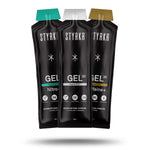
Count in grams from the label. One STYRKR GEL30, for example, is 30 g of carbohydrate, so one or two an hour covers the range. It contains no sodium.
Drink to thirst. For most people that works out at roughly 400 to 800 ml an hour, more in the heat. Don't force fluid down, and never drink so much that you gain weight during the race. Drinking far more than you sweat can dilute the sodium in your blood, which is dangerous, and electrolyte drinks don't protect you if you overdrink.
As a starting point, take 300 to 600 mg of sodium an hour in efforts over two hours, in heat, or if you sweat heavily. It can come from an electrolyte drink, from salty food you carry, or from the aid station tables. It is not proven to prevent cramp.
The gut adapts to what you ask of it. Practise your race fuelling on one long run a week for at least two weeks, ideally a month or more, and raise the amount by about 10 g an hour at a time. Every figure here is for healthy adults and is a starting point, not a prescription.
The detail is in our guide to ultra running nutrition, and the 50k fuelling plan has a worked example, hour by hour.
How to pace a first ultra
Start slower than feels reasonable, and walk before you need to.
There is some evidence for starting slowly. Researchers analysed a 100 km race that doubled as the World Masters Championships and split the finishers into four groups by finishing position. Measured against their own average speed, the fastest quarter ran the first 30 km more slowly than every other group. The slowest quarter ran it faster than the two middle groups, then ran relatively slower than the fastest quarter in the sixth and the final 10 km.
Everybody slows down. GPS traces from 15 runners in a hilly trail ultra of about 173 km showed speed falling on the flat, on the climbs and on the descents as the race went on. At the 161 km (100 miles) Western States Endurance Run, an analysis of 24 races found that the winners' speed varied less than that of the other top-five finishers. What you can do is slow down less than the people around you, and the first third of the race is where that gets decided.
In practice, pace by effort. Pace per kilometre means nothing on a climb, so take that screen off your watch. A workable rule for the first half is that you can speak in full sentences. Walk any climb steep enough to break that rule, and run the flats and gentle descents easily. This is convention among coaches, and Canaday's talk test above is one version of it.
Run-walk on the flat is fine too. Many first-timers find a fixed pattern, decided beforehand, easier to hold than a promise to run whenever it feels good.
Do the cut-off arithmetic once, before race day. Write the time you need to leave each aid station on your hand or your bottle, and you won't have to do sums at hour six.

What a first ultra is like, hour by hour
What follows uses a 50 km that takes about seven hours, the same example as our 50k fuelling plan. Stretch or shrink it to fit your race. Apart from the studies named, it is the common account from coaches and runners, and no more than that.
Before the start
Eat breakfast 2 to 3 hours before the start, and make it the one you've eaten before long runs. Registration, the kit check and the toilet queue all take longer than you would think, so arrive early.
Hour one
It feels too easy, and it should. People will stream past you on the first climb. Let them go, and walk it. Eat for the first time at 30 to 45 minutes even though you aren't hungry.
Hours two and three
The field thins out and you may be alone for stretches, so watch for the course markings yourself. You'll reach an aid station. Fill your bottles first, take food you recognise, and walk out eating. Ten minutes standing at each of five stations adds fifty minutes to your finishing time.
Hours four and five
Somewhere in here you pass the longest you have ever been on your feet. Your legs ache, and the descents hurt more than the climbs. Mood often drops, sometimes sharply and for no clear reason. Experienced runners say these patches pass, and that eating is the first thing to try.
Your stomach may turn. That is common in long races. In a survey of 272 runners at the 161 km Western States Endurance Run, 60% reported nausea, and it was worst in the hardest and hottest part of the course. Slow to a walk, sip, and start again with small amounts. Our nutrition guide covers what to do in more detail.
Hours six and seven
You're walking more and counting down the aid stations. Sweet food may have lost its appeal, so eat whatever you will still eat. Keep answering the alert on your watch, because the last hour is when eating tends to get skipped. If you paced the morning well, you will be passing people who didn't.
After the finish
You'll get cold within minutes of stopping, so put on dry layers before anything else. Within the first hour or two, have 20 to 40 g of protein and about 1 g of carbohydrate per kg of body weight. Expect stairs to be difficult for a few days, going down especially. If you are driving home, plan for a sleep first or a second driver. Our guide to recovering from an ultra marathon covers the week that follows.
Common ways a first ultra goes wrong
Starting at marathon effort
This is the mistake the pacing research describes. Nothing feels wrong for the first two hours, and the cost comes in the second half.
Letting the eating slide
In a survey of 500 entrants at two 161 km races, nausea or vomiting was the main reason non-finishers gave for dropping out, at 23%. Those races are more than three times the length of a 50 km, so don't expect the same odds. The habit that helps is the same at any distance. Eat early and by the clock, and when you feel sick, slow down and keep taking small amounts.
Feet
In the same survey, 40% of finishers said blisters had affected their race. Race in shoes and socks you have worn for your longest runs. When you first feel a hot spot, stop and deal with it. Five minutes with tape at an aid station is cheap compared with 20 km on a blister.
Cramming training late
A long run squeezed in ten days before the race to prove you can do it adds fatigue and very little fitness. Koop's view is that wanting reassurance is a poor reason for a long run.
New kit on the day
A vest that rubs or shoes half a size out won't show up in the first hour. Everything you race in should have done a long run first.
Missing a turn
Marked courses still get missed, often by a tired runner following the person in front. If the organiser provides a route file, load it onto your watch or phone, and look for the next marker yourself.
Getting cold
You make less heat walking than running, and a first ultra involves a lot of walking late on, often as the day cools. That is what the jacket, hat, gloves and spare layer on the kit list are for. Put them on before you start to shiver.
Frequently asked questions
How many miles a week do you need to run for a 50k?
Do you have to run the full distance in training before an ultra?
Sources
- How Much Do You Need to Train for an Ultramarathon? (Jason Koop; page shows updated 22 July 2026). CTS / TrainRight. https://trainright.com/ultramarathon-training-time-required/
- How Long Should Your Longest Run Be Before An Ultramarathon? (Jason Koop; updated 27 March 2026). CTS / TrainRight. https://trainright.com/longest-run-ultramarathon-training/
- Block training for ultrarunning (Jason Koop; updated 7 March 2025). CTS / TrainRight. https://trainright.com/block-training-ultrarunning-ultramarathon/
- Ultrarunners' pre-race dos and don'ts (Jason Koop; updated 7 March 2025). CTS / TrainRight. https://trainright.com/ultrarunners-pre-race-dos-donts/
- Endurance-Based Workouts for Ultramarathon Training (Ian Torrence; 1 November 2022). iRunFar. https://www.irunfar.com/endurance-based-workouts-for-ultramarathon-training
- How Long Does It Take To Train For An Ultramarathon? (Katelyn Tocci; updated 25 March 2026). Marathon Handbook. https://marathonhandbook.com/how-long-does-it-take-to-train-for-an-ultramarathon/
- Your guide on knowing when to powerhike (Sage Canaday; 20 October 2024). Higher Running. https://higherrunning.com/your-guide-on-knowing-when-to-powerhike/
- Hoffman MD, Krishnan E. Exercise behavior of ultramarathon runners: baseline findings from the ULTRA study. J Strength Cond Res 2013. Journal of Strength and Conditioning Research. https://doi.org/10.1519/JSC.0b013e3182a1f261
- Knechtle B, Nikolaidis PT. Physiology and Pathophysiology in Ultra-Marathon Running. Front Physiol 2018;9:634. Frontiers in Physiology. https://doi.org/10.3389/fphys.2018.00634
- Bontemps B et al. Downhill Running: What Are The Effects and How Can We Adapt? A Narrative Review. Sports Med 2020. Sports Medicine. https://doi.org/10.1007/s40279-020-01355-z
- Hottenrott K et al. Does a run/walk strategy decrease cardiac stress during a marathon in non-elite runners? J Sci Med Sport 2016. Journal of Science and Medicine in Sport. https://doi.org/10.1016/j.jsams.2014.11.010
- Renfree A, Crivoi do Carmo E, Martin L. The influence of performance level, age and gender on pacing strategy during a 100-km ultramarathon. Eur J Sport Sci 2016. European Journal of Sport Science. https://doi.org/10.1080/17461391.2015.1041061
- Kerhervé HA et al. Pacing during an ultramarathon running event in hilly terrain. PeerJ 2016;4:e2591. PeerJ. https://doi.org/10.7717/peerj.2591
- Hoffman MD. Pacing by winners of a 161-km mountain ultramarathon. Int J Sports Physiol Perform 2014. International Journal of Sports Physiology and Performance. https://doi.org/10.1123/ijspp.2013-0556
- Stuempfle KJ, Hoffman MD. Gastrointestinal distress is common during a 161-km ultramarathon. J Sports Sci 2015. Journal of Sports Sciences. https://doi.org/10.1080/02640414.2015.1012104
- Hoffman MD, Fogard K. Factors related to successful completion of a 161-km ultramarathon. Int J Sports Physiol Perform 2011;6(1):25-37. International Journal of Sports Physiology and Performance. https://doi.org/10.1123/ijspp.6.1.25
- Arc 50K race page. Arc of Attrition by UTMB. https://arcofattrition.utmb.world/races/Arc50K
- South Downs Way 50 2027 race page. Centurion Running. https://centurionrunning.com/races/south-downs-way-50-2027
- Race to the Stones event page. Threshold Trail Series. https://thresholdtrailseries.com/race-to-the-stones/