Ultra marathon kit list: mandatory kit, water and food
What UK race organisers make you carry, and how much fuel and fluid goes in the vest with it.

By Jake Vita, Head of Marketing
- Published
- 13 min read
Key takeaways

Contents11 sections
- Key takeaways
- What is mandatory kit for an ultra marathon?
- Ultra marathon kit list for a first race
- Do you need your own cup for an ultra?
- How much water to carry on an ultra
- Soft flasks, bottles or a bladder?
- How much food to carry between aid stations
- Emergency food for an ultra and how many calories it needs
- Where to pack food so you can reach it with cold hands
- Frequently asked questions
- Sources
The mandatory kit lists of UK ultras overlap heavily. Five of them, read on 19 November 2026, ask for much the same things: a waterproof jacket with taped seams, a head torch with a backup, something to wrap yourself in if you have to stop, a charged phone, a cup, a way of carrying water and, at most of them, some food you are not allowed to eat. Buy to the strictest version of each and one set of kit will pass at most races.
What the lists leave out is the fuel. They give the least water you may carry and sometimes the least emergency food, and say nothing about how much you will eat between aid stations or where it sits in a vest. This page covers both. The list published by your own race is the one that counts, so read it before you buy anything and again in race week, because organisers change them.
What is mandatory kit for an ultra marathon?
It is the kit an organiser requires every runner to carry from start to finish, used or not. It exists for the runner who turns an ankle and has to sit still for several hours until help arrives, which is why a fast runner in good weather carries the same items as everyone else.
The five lists we read are the Arc of Attrition and Ultra-Trail Snowdonia (both UTMB World Series events, with near-identical lists), Centurion's South Downs Way 50, the Lakeland 50 and 100, and Race to the Stones. The first four check kit and act on it. Lakeland will not let you start without it. The two UTMB events will not hand over a race number, and can penalise up to disqualification for an item missing on the course. Centurion adds an hour to your time for each missing item.
Race to the Stones is different. Its organiser publishes a list of things it advises you to carry, including a waterproof jacket, a charged phone, at least 750 ml of water and a head torch with spare batteries. Its 2026 event guide makes one item compulsory, a head torch worn between 8pm and 6am, and asks you to bring your own bottle to refill.
The table shows where the four enforced lists agree and where they don't. For the two UTMB events the figures are for the 50K races. The longer races ask for more.
| Item | Arc of Attrition and Ultra-Trail Snowdonia, 50K races | Centurion South Downs Way 50 | Lakeland 50 and 100 |
|---|---|---|---|
| Waterproof jacket | Hood, all seams taped or sealed, rated at least 10,000 mm | Sealed seams, rated at least 10,000 mm | Hood, taped seams. Windproof or showerproof is refused |
| Waterproof trousers | Yes, seams taped. Snowdonia may drop them 24 hours before the start | Not listed | Yes, taped seams |
| Light | One head torch of at least 300 lumens, with a spare battery | Two light sources of at least 100 lumens each. A phone does not count | Head torch with spare batteries, or a spare torch |
| If you have to stop | Survival or bivvy bag, at least 2.0 m by 0.7 m. Foil blankets are refused | Survival blanket, at least 1.4 m by 2 m | Survival blanket or survival bag |
| Cup | Optional on the 50K, required on the 100K and 100-mile. At least 150 ml, and soft ultra-light cups are not permitted | Required. Soft or heat-resistant | Required. Solid plastic that does not collapse |
| Emergency food | Required and kept separate from race food. At least 400 kcal recommended | Not listed | Required, sealed in a bag. "2 chocolate bars or similar" |
| Water capacity | 1.0 litre. The 100K and 100-mile races need 1.5 litres | 1 litre | A bottle or soft flask. No volume given |
All four also list a charged mobile phone, a whistle, a hat and gloves, and a long-sleeved warm layer. Centurion and Lakeland want that layer as a spare, kept dry and unworn until you need it. Snowdonia can drop some of its 50K items 24 hours before the start if the forecast allows. Both UTMB lists are headed "For 2026" and were the versions linked from the event sites on the day we read them.
Two differences are worth buying around. A survival blanket passes at Centurion and Lakeland, while the Arc and Snowdonia refuse survival blankets and foil blankets, so if you might run either of those, buy the bivvy bag and check its size against each list. And spare batteries satisfy Lakeland while Centurion insists on a second light, so carry a second small torch and batteries for both.
Ultra marathon kit list for a first race
This is the overlap of those lists, written for a first ultra of 50 km to 50 miles in the UK. Where your race's list says something different, follow the race.
- A running vest or pack that holds everything below
- Trail shoes. The Arc, Snowdonia and Lakeland lists refuse road shoes
- Waterproof jacket with a hood, taped seams and a rating of at least 10,000 mm
- Waterproof trousers with taped seams
- A long-sleeved warm layer, kept dry in a bag
- Warm hat and gloves
- Head torch, a second light, and spare batteries for each
- Survival bag
- Mobile phone, fully charged, with the race emergency numbers saved
- Whistle
- Compass, and the map if the race supplies one
- Small first aid kit with a bandage, blister supplies and any personal medication
- A rigid cup of at least 150 ml
- Flasks, bottles or a bladder with room for 1 to 1.5 litres
- Emergency food, sealed and kept apart from everything else
- Race food for the stretch to the next aid station
- Identification, and a bank card or some cash
When you choose the vest, pack the whole list into it before you commit, flasks full. The things to look for are two front pockets that take a 500 ml flask each, more front pockets you can reach without taking the vest off, and enough room in the back that the waterproofs go in without a fight. If you want named products, our gift guide is the place for those.

Do you need your own cup for an ultra?
At most of these races, yes. Lakeland provides no plastic cups or cutlery. Centurion provides no cups. The UTMB World Series regulations say no disposable cups, bowls or cutlery are handed out at any aid station.
The rules on what kind of cup pull in different directions. Lakeland wants a solid plastic cup for soup and hot drinks, and says that if it collapses in any way it isn't solid. Centurion accepts a soft cup for cold drinks or a heat-resistant one for hot, and suggests carrying both. The Arc's own pages disagree with each other. Its kit list makes a cup optional on the 50K and bans soft ultra-light ones, its FAQ says you need your own cup for drinks at aid stations, and its regulations list a "collapsible cup" among the mandatory items that carry a penalty.
A rigid plastic mug of 150 ml or more fits the Lakeland rule, the Centurion rule and the kit lists of both UTMB events as they are written. Lakeland also asks for a spork, and the UTMB events ask for your own bowl and cutlery if you'd like a hot meal on the longer races.

How much water to carry on an ultra
Drink to thirst. For most people that works out at roughly 400 to 800 ml an hour, more in the heat. Over a three-hour gap between aid stations that is 1.2 to 2.4 litres, so a 1 litre minimum may not last a gap that long.
Gaps of three hours do turn up on 50 km and 50-mile races. The organiser's slowest-runner schedule for the Arc 50K has the first aid station at 18.2 km, three hours and ten minutes after that schedule's start. On the South Downs Way 50 the first aid station is at 10.9 miles (17.5 km) and its cut-off is three hours after the start. After that, the legs at cut-off pace run from just over an hour to two hours forty.
So we would carry room for 1.5 litres on any race with a gap near three hours, and 2 litres if the forecast is hot. Snowdonia's hot weather kit, when the organiser keeps it in force, asks for the same 2 litres on its 50K. On the short legs, fill less, because a litre of water weighs a kilo. Check the rules first. The Arc and Snowdonia lists say you may be required to leave some aid stations with the minimum volume on board.
Capacity is what you are able to carry, and it is no instruction to drink it all. Do not force fluid down, and never drink so much that you gain weight during a race. Drinking far more than you sweat can dilute blood sodium (hyponatraemia), which is dangerous. Electrolyte drinks do not protect you if you overdrink.
Soft flasks, bottles or a bladder?
The Arc, Snowdonia and Centurion lists accept any of the three, and Lakeland names a bottle or soft flask. What follows is common practice among trail runners. It is not the result of a test.
Two 500 ml soft flasks in the front pockets suit most first ultras. You can see how much is left, you can fill them at a table without taking the vest off, and they shrink as you drink, so they don't slosh. Look for a wide opening, which makes it easier to fill from a jug and to drop in a tablet or powder, and a cap you can work with gloves on.
A bladder carries 1.5 or 2 litres in one place and lets you drink without using your hands. The costs come at the aid station. You can't see the level, and refilling means taking the vest off and digging the bladder out from under your waterproofs. It works best as extra capacity for a long gap or a hot day, filled once, with the flasks doing the routine work.
Hard bottles are the easiest to fill and to open with cold hands. They are bulkier, and a half-empty one sloshes. If your race has short gaps and you already own them, they are fine.
Whichever you choose, keep one container for plain water, so there is always something to wash a gel down with. And know what the station will put in them. At UTMB World Series races the regulations say the organiser supplies still water and an electrolyte or sports drink for filling bottles, and that other food and drink is for consuming in the aid station. Cola and soup go in the cup.

How much food to carry between aid stations
For a first ultra, plan on 30 to 60 g of carbohydrate an hour. Our ultra running nutrition guide explains where that range comes from. Every figure on this page is for healthy adults and is a starting point, not a prescription.
The unit to pack by is the gap, in hours. Work out how long each stretch between aid stations will take you, then multiply.
| Time to the next aid station | Carbohydrate to carry at 30 g an hour | Carbohydrate to carry at 60 g an hour |
|---|---|---|
| 1.5 hours | 45 g | 90 g |
| 2 hours | 60 g | 120 g |
| 3 hours | 90 g | 180 g |
| 4 hours | 120 g | 240 g |
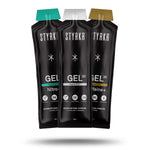
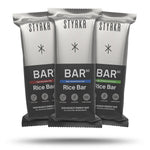
Then turn grams into things. Using STYRKR products as the example, a GEL30 is 30 g of carbohydrate and a GEL50 is 50 g. A pack of CEL50 chews is 50 g, all of it glucose, in five chews of 10 g each. A BAR30 is 30 g.
For a three-hour gap, one pack of chews, one GEL50 and one BAR30 come to 130 g, which is about 43 g an hour. Add a second GEL50 and you have 180 g, the top of the range. That is four items in a front pocket, and something to chew as well as something to swallow. None of it weighs much next to the water. A GEL50 holds 72 g of gel, and each full 500 ml flask is half a kilo of water.
The sodium needs checking too. The starting range is 300 to 600 mg an hour in efforts over two hours, which is 900 to 1,800 mg across a three-hour gap. The pack of chews carries 267 mg and the gels carry none. One SLT07 Berry 500 tablet in one of the flasks adds 500 mg. That makes 767 mg, short of the range, and this plan relies on salty food at the aid stations at either end for the rest. At these races that means crisps, sandwiches and, at some, soup.
Whatever brand you use, do the same sums from the label and write the plan in grams. For the count across a whole race, see how many gels for an ultra. If your race allows a drop bag, our crewing guide covers what goes in it. Mandatory kit stays on you.

Emergency food for an ultra and how many calories it needs
Emergency food is a reserve you carry and do not eat. The Arc and Snowdonia lists call it a "separate emergency food reserve" that must be unused at the finish unless you had an emergency and stopped on the course. Lakeland wants it sealed in a bag and is blunt that food you plan to eat on the route is not emergency food.
How much varies. The two UTMB lists recommend at least 400 kcal and describe that as one gel and one energy bar, or two gels. Lakeland asks for "2 chocolate bars or similar" with no calorie figure. Ultra X, in a kit article dated October 2023, asks for 800 kcal that is still in the pack at the finish line and gives two large flapjacks as the example. Centurion's South Downs Way 50 list has no emergency food on it.
Don't trust "two gels" as a measure. It reaches 400 kcal only if each gel is about 200 kcal, and a smaller gel won't get there. Read the kcal on the packet and add it up.
From the STYRKR product record, a GEL50 is 200 kcal and a BAR50 is at least 250 kcal. Two GEL50 make 400 kcal, which lands on the line with nothing spare. One GEL50 and one BAR50 make at least 450 kcal. For a race that wants 800 kcal, two of each make at least 900.
We would put at least one bar in the reserve, because it takes the total clear of the line. Seal the reserve in a small bag, put it at the bottom of the pack and leave it out of your fuelling sums. Check the dates on it before each race.
Where to pack food so you can reach it with cold hands
Think of the vest as two zones. The front is for what you will use before the next aid station. The back is for what you hope not to use at all.
- Front pockets: both flasks, the food for this gap, and the cup, since it comes out at every station
- One front or side pocket kept empty for wrappers
- Top of the back compartment: waterproof jacket and trousers, hat and gloves
- Middle of the back: the dry bag with your warm layer, and the next gaps' food
- Bottom of the back: survival bag, first aid kit, spare light and the sealed emergency food
At each aid station, fill the flasks first, then move the next gap's food from the back to the front before you leave. That one habit means you never have to take the vest off on the trail to eat.
Cold changes what you can open. The Arc, in January, makes warm waterproof gloves mandatory, and a wrapper that tears easily in a warm kitchen can be beyond you in wet gloves. Runners who race in winter commonly put food that needs no unwrapping in the easiest pocket, start the tear on bar wrappers before the start, and carry gels in the pocket nearest the body so they stay soft. That is practice passed between runners, with no trial behind it. Our Arc of Attrition fuel and carry guide goes further into eating in the cold.
Test it before race day. Do one long run in the full race pack with the flasks full, wearing the gloves you'll race in, and eat everything on your plan for one gap without stopping.
Frequently asked questions
Can I put mandatory kit in my drop bag?
What happens if I fail a kit check?
Do I need waterproof trousers for an ultra?
Sources
- Arc of Attrition Mandatory Kit V2.0 (PDF, headed 'For 2026'). Arc of Attrition by UTMB. https://pdf.utmb.world/image/upload/v1752166072/arcofattrition/Arc_of_Attrition_Mandatory_Kit_V2_0_846a02b0f6.pdf.pdf
- Mandatory Kit (page). Arc of Attrition by UTMB. https://arcofattrition.utmb.world/runners/mandatory-kit
- Race regulations. Arc of Attrition by UTMB. https://arcofattrition.utmb.world/regulations
- FAQs. Arc of Attrition by UTMB. https://arcofattrition.utmb.world/faqs
- Arc 50K race page (Time Charts data). Arc of Attrition by UTMB. https://arcofattrition.utmb.world/races/Arc50K
- Ultra-Trail Snowdonia Mandatory Kit V2.0 (PDF, headed 'For 2026'). Ultra-Trail Snowdonia by UTMB. https://pdf.utmb.world/image/upload/v1775650665/snowdonia/Pages/Ultra_Trail_Snowdonia_Mandatory_Kit_V2_0_46abdddfa8.pdf.pdf
- Mandatory Kit (page). Ultra-Trail Snowdonia by UTMB. https://eryri.utmb.world/races-runners/runner-info/mandatory-kit
- South Downs Way 50 2027, FAQs (mandatory gear, aid station food). Centurion Running. https://centurionrunning.com/races/south-downs-way-50-2027/section/faqs
- South Downs Way 50 2027, Infopack (aid station chart and cut-offs). Centurion Running. https://centurionrunning.com/races/south-downs-way-50-2027/section/infopack
- Why/What Mandatory Gear?. Centurion Running. https://centurionrunning.com/section/resources/whywhat-mandatory-gear
- Kit requirements. Lakeland 50 and 100. https://lakeland100.com/kit-requirements/
- Your ultra-marathon kit list guide. Threshold Trail Series (Race to the Stones). https://www.thresholdtrailseries.com/your-ultra-marathon-kit-list-guide/
- Race to the Stones Event Guide 2026 (PDF). Threshold Trail Series. https://www.thresholdtrailseries.com/app/uploads/2026/06/2627-rtts-event-guide-2026-v2-1.pdf
- Mandatory ultra marathon essentials kit list (Sam Heward, 23 October 2023). Ultra X. https://ultra-x.co/blog/mandatory-ultra-marathon-essentials-kit-list/